Yoga Nidra and metacognition

Metacognition is not about thinking harder. It is about seeing your thinking clearly.
Most of us live inside our thoughts without realising it.
We build narratives about the future, replay conversations from the past, analyse situations repeatedly, and react to circumstances almost automatically.
We worry, decide, judge, and respond, often without pausing to observe how the mind is operating in the first place.
The issue is not that we think too much; it is that we rarely step outside our thinking to examine it.
And that capacity to step back is where transformation begins.
What is metacognition?
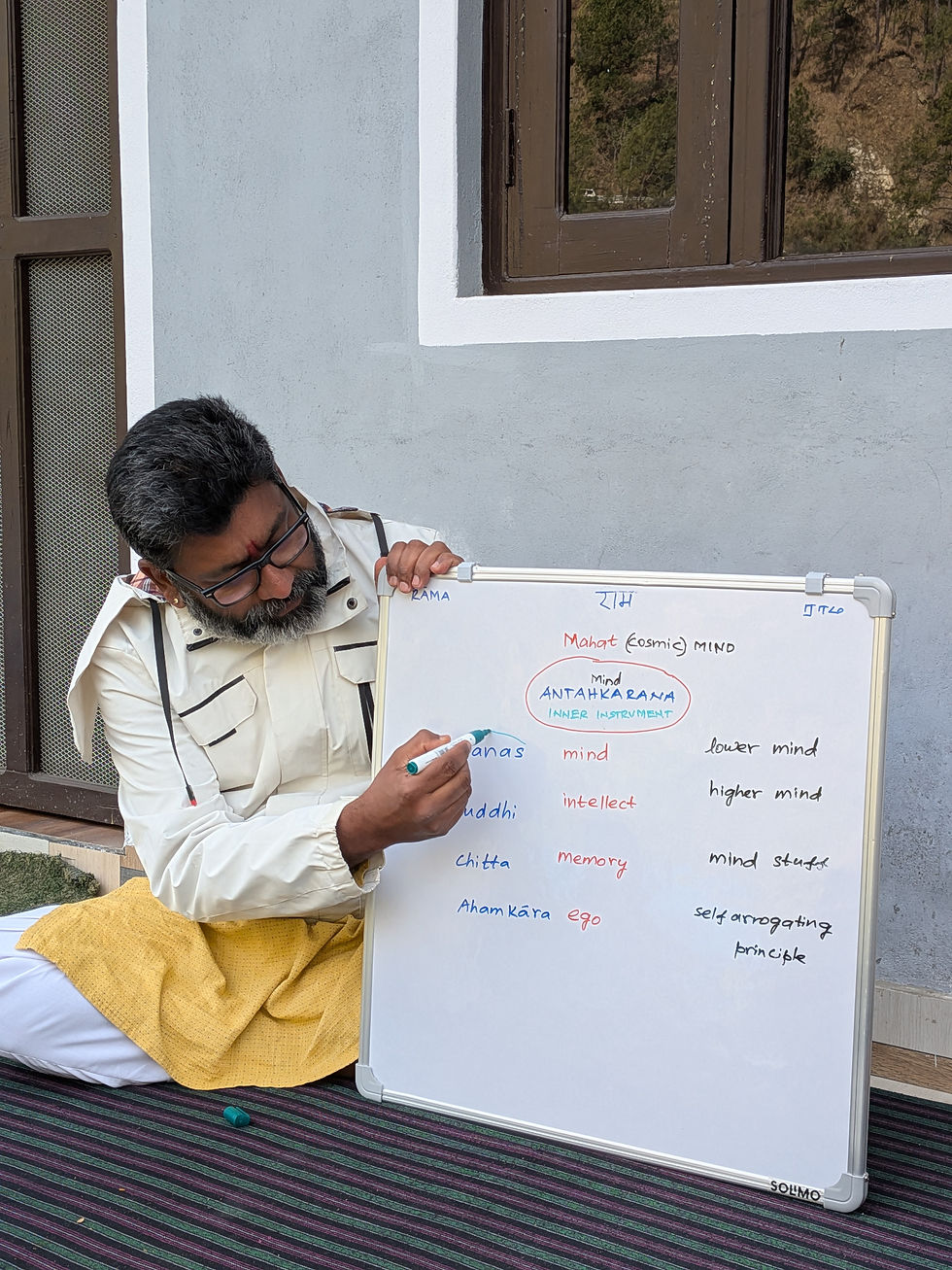
Metacognition is the ability to observe the mind at work.
It is the quiet skill of noticing your own patterns of thought and response. In moments of awareness, three simple questions can become powerful anchors:
What am I thinking right now?
How did this pattern emerge again?
Is this response necessary, or habitual?
In leadership, learning, relationships, and personal growth, this ability fundamentally changes the quality of decision-making and self-regulation.
Where ‘Shrimath Yoga Nidra’ becomes powerful
Unlike relaxation techniques that aim to silence the mind, Shrimath Yoga Nidra gently trains awareness to remain present while the mind continues its activity.
The objective is not suppression but observation.
The mind may continue producing thoughts, sensations, and emotions, yet awareness learns to remain steady.
With repeated practice, participants begin to notice subtle but profound shifts:
The gap between stimulus and response
The distinction between thought, emotion, and identity
When attention drifts and how it returns
How intention forms before action
How the body reacts before the mind constructs a narrative
This is metacognition not as an abstract concept, but as an embodied skill.
How the practice cultivates this capacity
In ‘Shrimath Yoga Nidra,’ awareness is guided systematically through the body, breath and beyond.
One is neither asleep nor actively analysing, but simply present.
Over time, what is traditionally called the ‘witness attitude,’ strengthens.
At more advanced stages, including Antar Mouna, practitioners are not instructed what to think.
Instead, they learn to observe how thinking itself unfolds. With consistency, a quiet yet significant shift occurs:
Thoughts are noticed but not automatically believed.
Emotions are experienced without reflexive reaction.
Decisions begin to arise from clarity rather than compulsion.

Why this matters today
In a world of constant stimulation and rapid response cycles, metacognition becomes essential.
It supports:
Better learning and unlearning, as evolving needs replace rigid assumptions.
Emotional regulation, because the pause allows reflection before reaction.
Conscious leadership, where timing and method are as considered as outcomes.
Effective communication, as modulation and pause become natural.
Reduced reactivity under pressure, with measured responses replacing impulsive ones.
Greater alignment between values and action, as awareness creates that critical split second of choice.
In simple terms, you stop being run by your mind and begin relating to it wisely.
The deeper promise
‘Shrimath Yoga Nidra’ does not offer shortcuts.
It offers disciplined and compassionate training in awareness.
From awareness comes clarity.
From clarity comes choice.
From choice comes freedom.
Learn more: https://www.shrimathyoganidra.com/intermediate


Comments